Earning Passive Income Through Selling Contracts
Wholesaling Real Estate the Legal Michigan Way
Wholesaling Real Estate Legally in Michigan
Are you an aspiring entrepreneur looking to dive into real estate without a massive upfront investment?

Wholesaling real estate in Michigan could be your ticket to generating passive income, and the best part?
It’s completely legal when done right. This strategy lets you profit by facilitating property deals without ever owning the property yourself.
But before you jump in, you need to understand Michigan’s laws to stay compliant and build a sustainable business.
Disclaimers!: The Real Estate HUB is a education platform, Furthermore, The Real Estate HUB and its affiliates are not licensed financial advisors or consultants, nor are they lawyers or attorneys at law. The Real Estate HUB is not a licensed real estate broker. Please DYOR and speak to professionals. We claim NO responsibility for any financial investment or legal decisions you make. The Real Estate HUB is an Amazon & Sovrn Commerce affiliate. Some links in this article will take you to Treh.MI favorite products, and we may earn a commission from your purchases at no extra cost to you.

https://medium.com/@TheRealEstateHUB/subscribe
Let’s break down what wholesaling is, how it works, and how to do it legally in the Great Lakes State as of July 13, 2025.
What Is Wholesaling, and Why Should You Care?
Wholesaling is like being a matchmaker for real estate deals.
You find a motivated seller, sign a contract to buy their property at a bargain price, and then pass that contract (or the property itself) to another buyer — usually an investor — for a higher price.

Your profit comes from the difference, called an assignment fee in the assignment method or a markup in a double closing.
It’s a low-risk way to enter real estate, perfect for entrepreneurs who want to generate income without needing a huge bankroll or a real estate license — within certain limits.
The beauty of wholesaling lies in the doctrine of equitable conversion, a legal principle that gives you an equitable interest in the property once you sign a purchase agreement.
This means you don’t own the property outright, but you have the right to buy it, which you can sell to someone else. Think of it as selling your spot in line for a hot new product — you’re not selling the product itself, just your place in the queue.
Is Wholesaling Legal in Michigan?
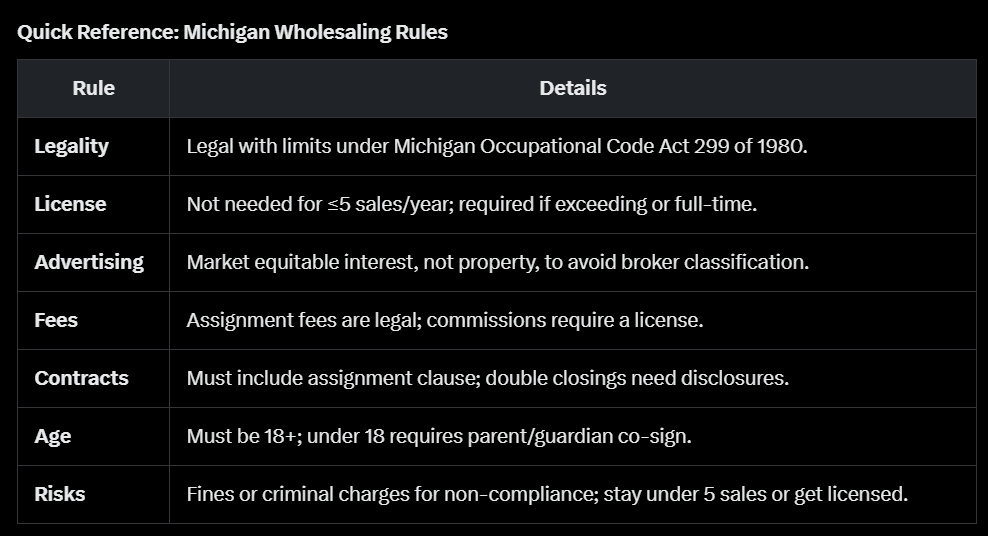
Yes, wholesaling is legal in Michigan, but it comes with guardrails.

The Michigan Occupational Code Act 299 of 1980, enforced by the Michigan Department of Licensing and Regulatory Affairs (LARA), sets the rules.
Here’s the deal:
you can wholesale without a real estate license as long as you’re selling your equitable interest in the contract (via the assignment method) and not acting as a broker.
A broker, for example, represents others in buying or selling property for a commission, which requires a license.

Wholesalers, on the other hand, deal with their own contract rights.
However, Michigan limits unlicensed individuals to five real estate sales per year. If you’re wholesaling more than five properties in a 12-month period, advertising yourself as a full-time real estate pro, or spending over 50% of your work time (or 15 hours a week for six months) on these deals, you might need a broker’s license.
Exceeding these limits could land you in hot water, so plan carefully if you’re aiming to scale.
The Two Main Wholesaling Methods
Let’s explore the two primary ways to wholesale in Michigan:
Assignment Method: This is the most common approach. You sign a purchase agreement with a seller, including an assignment clause that allows you to transfer the contract to another buyer.

You then find an investor willing to pay more and assign your equitable interest to them for a fee.
For example, you contract to buy a property for $100,000 and assign it to an investor for $110,000, pocketing the $10,000 assignment fee. It’s quick, low-cost, and doesn’t require you to close on the property.
Double Closing: In this method, you actually buy the property and then immediately sell it to your end buyer, often on the same day.
For example, you purchase a property for $100,000 and sell it to an investor for $115,000, keeping the $15,000 difference.
This requires more capital (or creative financing like hard money loans) and involves more paperwork, including disclosures like lead-based paint forms.
Double closings are less common but useful when a seller or buyer prefers a traditional sale.

Both methods rely on the doctrine of equitable conversion, which ensures your equitable interest in the contract is a legally recognized asset you can sell or assign.
Navigating Michigan’s Advertising Rules
One of the trickiest parts of wholesaling is marketing your deals without crossing legal lines.
Michigan law is clear: only licensed brokers or property owners can advertise a property for sale.
As a wholesaler, you’re not the owner — you hold an equitable interest.

So, when you market your deal, you must advertise that you’re selling your contract rights, not the property itself.
For example, instead of posting, “For Sale: 3-Bedroom House in Detroit, $120,000,” say, “Assigning My Contract for a Property in Detroit — Contact for Details!”
This distinction keeps you compliant with Section 339.2512e of the Occupational Code.
Getting this wrong could make you look like an unlicensed broker, leading to fines or legal trouble.
Be crystal clear in your ads, emails, and conversations that you’re selling your interest in the contract.
Fees vs. Commissions: Know the Difference
Here’s a key legal nuance: wholesalers can collect an assignment fee for transferring their contract, but they cannot collect a commission without a license.

A commission is what brokers earn for facilitating a sale on someone else’s behalf, and it’s off-limits for unlicensed wholesalers under MCL 339.2512(1)(h).
Your assignment fee, however, is fair game because it’s payment for your equitable interest, not for brokering a deal.
Structure your contracts to reflect this, and you’ll stay on the right side of the law.
Ethical Wholesaling and Transparency
Wholesaling has its critics, with some arguing it exploits sellers by locking up properties at low prices.

To build a reputable business, transparency is key. Always disclose to the seller that you plan to assign the contract or resell the property.
Include a clear assignment clause in your purchase agreement, and provide proof of funds to show you could buy the property if needed.
In a double closing, ensure all required disclosures (like seller or lead-based paint disclosures) are provided to the buyer.
Ethical wholesaling not only keeps you legal but also builds trust, which is crucial for long-term success.
As an aspiring entrepreneur, your reputation is your brand — protect it by being upfront with all parties.
Practical Tips for Aspiring Wholesalers
Ready to start wholesaling in Michigan? Here are actionable tips to kickstart your journey:
- Learn the Law: Dive into the Michigan Occupational Code Act 299 of 1980 (available at Michigan Legislature). Understanding the rules will keep you compliant and confident.
- Craft Solid Contracts: Use contracts with a clear assignment clause for the assignment method. For double closings, work with a title company familiar with simultaneous closings. A real estate attorney can review your contracts for peace of mind.
- Market Smart: Advertise your equitable interest, not the property. Use phrases like “Selling my contract rights” in your marketing materials, whether on social media, bandit signs, or direct mail.
- Consider a License: If you plan to wholesale more than five deals a year or make it your full-time gig, get a real estate license. Joining a Michigan brokerage is straightforward and eliminates legal risks. Check out Real Estate Bees for licensing steps.
- Form an LLC: While not required, setting up a limited liability company protects your personal assets and offers tax benefits. It’s a smart move for any entrepreneur.
- Consult an Attorney: A real estate lawyer can guide you through contracts and compliance. Firms like Fausone & Grysko, PLC, offer free consultations (call 248–380–0000 or visit their site).
- Stay Ethical: Be transparent with sellers and buyers. Clear communication builds trust and reduces the risk of disputes.
Risks and Controversies While wholesaling is legal, it’s not without risks. Exceeding the five-sale limit without a license or marketing improperly could lead to fines or criminal charges from LARA.
Some critics, like those at MichiganRealty.org, argue wholesaling should face stricter regulations, claiming it can exploit desperate sellers.
However, as of July 13, 2025, the laws remain favorable for wholesalers who follow the rules.Another consideration: you must be 18 to enforce contracts in Michigan. If you’re younger, you’ll need a parent or guardian to co-sign.
Also, while enforcement actions against wholesalers are rare, staying informed about potential regulatory changes is wise.
Why Wholesaling Is Perfect for Passive Income Seekers
Wholesaling is a dream for entrepreneurs chasing passive income.
It requires minimal upfront cash, no property ownership, and can be done part-time. With the assignment method, you’re in and out of deals quickly, earning fees without the headaches of renovations or landlord duties.
Even a double closing, while more involved, can yield bigger profits. By mastering Michigan’s laws, you can turn wholesaling into a steady income stream, all while building a network of investors and sellers for future opportunities.
Get Started Today
Wholesaling real estate in Michigan is a legal, accessible way to break into real estate and build passive income.
By leveraging the doctrine of equitable conversion, selling your equitable interest, and choosing between the assignment method or double closing, you can create a profitable business with minimal risk.
Stick to the five-sale limit, market your contract rights properly, and prioritize transparency to stay legal and ethical. Ready to take the plunge?
Study the Michigan Occupational Code, connect with a real estate attorney, and start hunting for deals.
For more insights, check out resources like Ark7’s Michigan Wholesaling Guide or Fausone & Grysko’s legal blog. With the right approach, wholesaling could be your first step toward financial freedom in Michigan’s vibrant real estate market.
Find The Real Estate HUB on Social 👇
- X: The Real Estate HUB / JaceCamMedia
- Youtube: MichiganREIHQ
- Facebook: The Real Estate HUB
- IG: Michigan_REI
- TikTok: Real_MichiganEstates
- Trehmichigan.blogspot.com
Thank you for reading The Real Estate HUB
The Real Estate HUB and its affiliates are not Licensed Financial Advisors, Consultants, nor are lawyers or attorneys at law. The Real Estate HUB is also not a licensed broker. Please DYOR and speak to professionals. We claim no responsibility for any financial or legal decisions you make.
https://medium.com/@TheRealEstateHUB/subscribe


Comments
Post a Comment